
Why Your Patio Door Won’t Slide Anymore, and How Houston Homes Get Their Flow Back
Think about what a sliding patio door actually does for a Houston home. It is the wall that disappears. One smooth motion and the living room opens onto the patio, the pool, the backyard grill, or a quiet morning with coffee and humid Gulf Coast air. In neighborhoods like The Heights, Sugar Land, Katy, Pearland, and Cypress, these doors are often the single largest window in the house, and they carry a lot of emotional weight for that reason. They are where kids run in and out all summer. They are where natural light pours into a kitchen that would otherwise feel closed off.
So when that door stops gliding and instead grinds, drags, or refuses to budge at all, it is not just an inconvenience. It is frustrating in a personal way. Homeowners tell us they feel almost embarrassed, like something is wrong with their house that they should have caught sooner. We want to say clearly: it is not your fault. Sliding patio doors in this region face a punishing combination of soil movement, humidity, and sun exposure that doors in most other U.S. cities simply never encounter. Understanding why your door struggles is the first step toward a real, lasting fix.

The Silent Culprit: How Houston’s Active Clay Soil and Humidity Destroy Sliding Doors
Most homeowners assume a stuck door is a hardware problem, but in Houston the real story usually starts underground. Southeast Texas sits on a soil type often called Houston Black Clay, and it behaves nothing like the sandy or loamy ground found elsewhere in the country. This clay can swell by as much as 10 percent when it absorbs water and then shrink back down sharply during dry, hot stretches. That cycle does not happen once a year. In Houston’s climate, with its heavy spring rains followed by scorching, dry summer weeks, the soil beneath your slab foundation is essentially in constant motion.
That movement does not stay underground. As the clay swells and contracts unevenly across the footprint of your home, it lifts one section of the slab while another settles slightly lower. Your house frame twists in response, even if the shift is only a fraction of an inch. Door and window openings are usually the first place this shows up, because a sliding door frame has almost no give. When the frame racks even slightly out of square, the track rail that used to sit perfectly level starts tilting. The rollers that were designed to run smoothly on a flat surface now fight gravity and friction with every pass.
Humidity compounds the problem from a completely different angle. Southeast Texas air carries a heavy moisture load almost year-round, and that moisture is relentless on metal hardware. Steel rollers, screws, and track components that are not properly sealed or coated begin to oxidize. Rust does not just look bad; it physically swells the metal, causing rollers to bind inside their housings and tracks to develop a rough, pitted surface that grinds against the wheel bearings every time the door moves. Combine soil-driven frame distortion with humidity-driven corrosion, and you get the two forces that, more than anything else, explain why so many Houston sliding doors fail years before their glass or frame would otherwise wear out.
The Mechanical Anatomy of a Sliding Patio Door
To really understand why a door sticks, it helps to know what is actually happening inside the frame every time you push it open. A sliding patio door is a small mechanical system, and like any system, it only takes one worn part to throw the whole thing off.
Tandem Rollers and Wheel Bearings
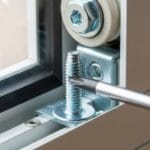
Most residential sliding doors ride on tandem rollers, which are pairs of small wheels mounted at each bottom corner of the sliding panel. These rollers can be made from steel, brass, or nylon, and the material matters more than most homeowners realize. Steel rollers are strong but vulnerable to Houston’s humidity and will rust over time if not maintained. Brass resists corrosion better but can wear down under the weight of a large glass panel. Nylon rollers are quiet and corrosion-resistant, yet they can develop flat spots or crack if the door sat stuck for an extended period before repair. Each roller rides on a small internal bearing, and once that bearing dries out or fills with grit, the smooth rolling motion turns into a dragging, catching motion that gets worse every week.
The Metal Track Rail
The track rail is the aluminum or steel channel the rollers travel along, and it is far more fragile than it looks. In a Houston backyard, that track collects a steady mix of pollen, dust, dried grass clippings, and pet hair. Once that debris mixes with old lubricant, it forms a gritty paste that acts almost like sandpaper every time the door slides across it. What started as smooth rolling motion slowly turns into a grinding motion that wears grooves into both the track and the rollers. A bent or dented track, which can happen from foundation shift or from someone forcing a stuck door, makes the problem far worse because the rollers are now trying to travel over an uneven surface no matter how clean it is.
Locking Systems and Frame Keepers
The lock on a sliding door is not just a security feature, it is also a diagnostic tool. When a door frame shifts due to foundation movement, the latch keeper mounted on the fixed panel no longer lines up with the hook or bolt on the sliding panel. Homeowners often notice this before anything else: the door still slides, but the lock will not catch, or it takes serious effort to force it closed. This is a genuine security risk, since a door that cannot latch fully is far easier to pry open from the outside. If your patio door has started requiring a shoulder bump or a hard yank to lock, treat that as an early warning sign, not just a nuisance.
Weather Stripping and Interlocking Seals
Along the edges of the sliding panel and where it meets the fixed panel, a strip of vinyl or foam weather seal keeps conditioned air inside and Houston’s humid outdoor air outside. Years of UV exposure from the intense Texas sun dries this material out, causing it to crack, shrink, and pull away from the frame. Once that seal fails, homeowners often notice a spike in their summer cooling bills, along with drafts, dust intrusion, and even a faint whistling sound on windy days. Failing weather stripping rarely gets a homeowner’s attention the way a stuck door does, but it is quietly costing money every single month it goes unaddressed.
Glass Failures and the Mystery of Foggy Double-Pane Doors
If your sliding door glass has developed a permanent hazy or foggy patch that will not wipe away no matter how hard you clean it, the glass itself is telling you something important. Modern sliding doors use insulated glass units (IGUs), meaning two panes of tempered glass separated by a sealed air gap, often filled with argon gas for extra insulation. That seal is engineered to last for years, but it is not immune to Texas conditions.
Here is what happens: during a scorching Houston afternoon, the air trapped between the panes heats up and expands. At night, or when a cold front moves through, that same air cools and contracts. Engineers call this repeated cycle thermal pumping, and it puts constant pressure on the seal at the edge of the glass unit. Every single expansion and contraction cycle stresses that seal microscopically, and over enough years, especially with the extreme temperature swings Houston sees between summer and winter, the seal eventually fails. Once it does, humid outside air seeps into the gap between the panes. That moisture condenses on the inner glass surfaces, and you get the permanent fog or haze that no amount of window cleaner will ever fix.
In our localized engineering experience, Houston homes see this failure noticeably earlier than homes in drier climates—often within 8 to 12 years instead of the standard 15 to 20-year lifespan you would expect elsewhere. The primary catalyst is our aggressive combination of high-UV solar radiation coupled with rapid tropical pressure changes.
The Safety Risks and Physical Dangers of Stuck Patio Doors
It is easy to underestimate just how heavy a sliding glass door panel actually is. A standard residential unit typically weighs somewhere between 150 and 300 or more pounds, depending on the size of the glass and whether it is a double or triple pane insulated unit. That is not a door you want to force.
When a homeowner leans into a stuck door and yanks or shoves it, things can go wrong very quickly. The tempered glass can shatter under sudden localized stress, especially if the frame is already twisted from foundation movement. A door that suddenly breaks free after resisting can slam forward with dangerous momentum, which is a serious hazard for small children playing nearby, seniors with balance concerns, and family pets. We have also repaired cases where a forced door came off its track entirely and toppled. If your door requires real physical effort to open or close, treat that as an active safety issue rather than just a minor household annoyance.
Commercial and Automatic Sliding Doors in South Houston
Homeowners are not the only ones dealing with this problem. South Houston businesses, retail storefronts, medical offices, and restaurants rely heavily on automatic sliding door repair to keep entrances accessible, secure, and welcoming. Commercial automatic sliding doors face all the same environmental stress as residential units, plus the added wear of dozens or even hundreds of open and close cycles every single day.
A malfunctioning automatic sensor, a worn drive belt, or a misaligned commercial track can create real liability exposure for a business owner, from ADA accessibility concerns to the risk of a door closing on a customer. Commercial sliding door repair in South Houston also has to account for heavier duty hardware, higher traffic volumes, and often tighter timelines, since a business generally cannot afford to close its main entrance for days while waiting on parts. Whether you are managing a strip mall storefront or a larger commercial property, keeping automatic sliding door repair on a proactive maintenance schedule protects both your customers and your bottom line.

The DIY Reality Check: Why Repairing Heavy Sliding Doors Is Best Left to Professionals
We understand the instinct to grab a screwdriver and try to fix this yourself. Plenty of home projects are genuinely DIY-friendly, but a sliding patio door is a poor candidate for a few concrete reasons.
First, tempered glass is designed to shatter into thousands of tiny, relatively safe pieces under extreme stress, which is an excellent safety feature but a terrible thing to have happen while lifting a 200-pound panel off its track alone. Second, roller and track hardware is rarely universal. Manufacturers change specifications frequently, and matching an old roller style to what is currently available at a hardware store is genuinely difficult even for experienced contractors. Buying the wrong part often means a second trip and a door that still does not glide correctly. Third, a professional crew brings on-site mobile fabrication capability, meaning we can cut, adjust, and fit hardware and glass components on location. That combination of experience, correct parts, and the right tools is why quality sliding door repair in Houston, TX consistently outperforms a weekend DIY attempt, both in terms of how long the fix lasts and how safely it gets done.
Step-by-Step Home Audit for Your Patio Doors
Before you call anyone, including us, it helps to know exactly what you are dealing with. Walk through this quick audit on a weekend afternoon:
- Open and close the door slowly and listen. Grinding, scraping, or a rhythmic clicking sound usually points to worn or damaged rollers.
- Check whether the door drags more on one side than the other. Uneven resistance often signals foundation-related frame distortion rather than a simple roller problem.
- Inspect the track for visible dirt, dried debris, or a gritty residue. Try a gentle vacuum and a soft brush before assuming a part needs replacement.
- Test the lock. If it will not catch fully or requires force, note this immediately as both a mechanical and a security concern.
- Look closely at the glass for any permanent haze, fog, or moisture between the panes, especially in the early morning when condensation is most visible.
- Run a hand along the weather stripping. Cracked, brittle, or shrinking seals mean it is time for replacement before your next big utility bill arrives.
- Check for daylight or drafts around the frame edges, which can indicate both seal failure and potential frame misalignment from soil movement.
- Note whether nearby windows or interior doors are also sticking, since this is a strong sign the root cause is foundation movement rather than an isolated hardware issue.
- If you would also like a related check on your screens, a full professional window screen repair inspection often reveals the same humidity and UV wear pattern affecting your patio door.
Frequently Asked Questions
Can a bent track be saved, or does it need full replacement?
It depends on the severity of the bend. Minor dents from debris or light impact can often be carefully straightened and restored to a functional flat surface. Significant bends, especially those caused by ongoing foundation movement, usually need full track replacement, since a straightened but still uneven rail will continue to wear rollers prematurely.
How do I clean my sliding door tracks properly?
Start with a vacuum using a narrow attachment to pull out loose debris, then use a soft brush with a small amount of mild soap and water to loosen packed grime. Dry the track completely before applying a silicone-based lubricant, since water-based products or heavy grease actually attract more dirt over time in Houston’s humid climate.
Why is my door leaking water during heavy rain?
This usually points to failed or worn weather stripping, a damaged interlocking seal, or, in more serious cases, a frame that has shifted enough from foundation movement to create a gap that channels water inward. Given how frequently Houston sees intense rain events, addressing this quickly prevents interior water damage.
How much does sliding door repair in Houston typically involve?
Every home is different, since the fix might be as simple as roller replacement or as involved as full track and frame correction. A proper diagnosis on site is the only reliable way to know what your specific door needs.
Is it normal for a newer home to already have a sticking patio door?
Unfortunately, yes, especially in newer developments in areas like Cypress or Pearland where the soil is still settling after construction. Foundation movement does not care how new your home is, and homeowners are often surprised their five-year-old door already needs attention.
Can I just replace the glass without replacing the whole door?
In many cases, yes. If the frame, track, and hardware are still structurally sound, replacing only the foggy or failed insulated glass unit is often a more affordable path than a full door replacement.